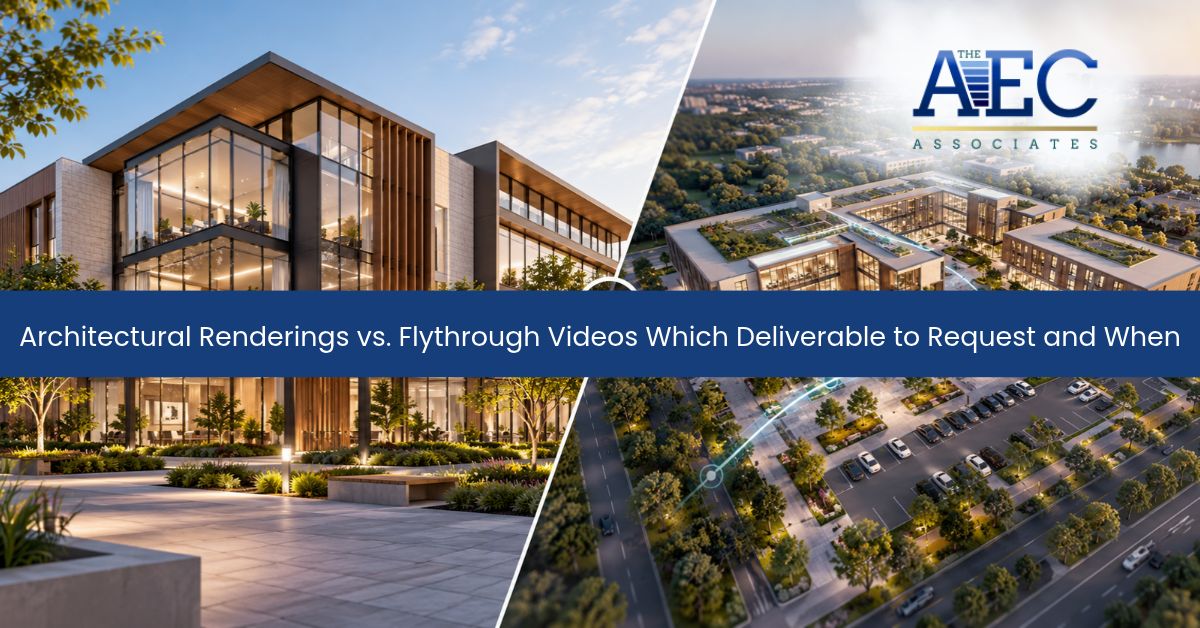
Choosing between architectural renderings vs. flythrough videos comes down to what the audience needs to understand, how developed the design is, and where the visuals will be used.
A client reviewing façade materials has different requirements from a developer presenting a commercial project to investors. Choosing the right format means matching the output to those specific needs.
The wrong format can lead to unnecessary revisions, missed communication opportunities, and avoidable production costs. Project teams should understand when to request each deliverable to plan visualization work more efficiently.
Why Choosing the Wrong Deliverable Costs More than Choosing the Right One
A visualization holds value when it can answer the audience’s immediate question. A technically excellent 3D architectural rendering is still the wrong tool when the recipient needs to understand spatial movement, not a static view.
What Still Rendering does that a Flythrough cannot
A still rendering is able to capture one carefully composed moment that can be printed, embedded in a design presentation, attached to an email or included in a planning submission.
Still images allow close examination of materials, lighting, proportions and architectural details for client approvals and design reviews. They make comparisons easier— two façade options can be displayed side by side, annotated and discussed without distracting movement.
Still renderings are especially useful when a decision depends on a precise visual reference that stakeholders can revisit throughout the project.
What a Flythrough does that a Still Rendering cannot
A flythrough communicates spatial sequence, scale and relationships between spaces. It enables viewers to understand how a visitor approaches a building, moves through an entry, enters the reception area or experiences the transition between indoor and outdoor areas.
A 30 – 60 second animation can create an immediate sense of the proposed facility for audiences unfamiliar with the site. This suits public consultations, leasing campaigns, educational facilities and investor presentations.
For related considerations when selecting animation formats, see architectural walkthroughs and flythroughs.
Decision Guide: Choosing Architectural Visualisation Services by Purpose
The following guide can be used when preparing a visualization brief.
Project Purpose | Recommended Deliverable | Practical Reason |
Design review with clients or consultants | Still rendering | Makes materials, proportions and design options easier to compare |
Planning or permit application | Still rendering | Submitted images are more practical than videos for formal documentation |
Investor or funding presentation | Stills + one flythrough | Stills support reports; animation supports the overall experience |
Real estate marketing | Multiple stills with optional animation | Real estate rendering supports portals, brochures and print collateral |
Public consultation | Flythrough | Helps unfamiliar audiences understand spatial relationships |
Social media or video campaigns | Flythrough | Provides a moving narrative suited to video-led content |
Leasing or student enrolment | Flythrough | Demonstrates how prospective tenants or students may experience the space |
3D exterior rendering services are especially useful for presenting building massing, facades, landscape integration and arrival views for exterior-led campaigns. A flythrough should be used when the campaign needs to communicate a sequence of experiences.
A combination of both can be ideal for many projects.
Project Stage: When Architectural Visualization is Most Effective
Schematic and Design Development Stage
Still renderings are usually the more practical choice during schematic design (SD) and design development (DD). They enable clients to evaluate massing, façade treatments, materials and lighting and allow design teams to retain flexibility.
If a flythrough is created very early, it may require substantial revision when layouts, circulation or building geometry changes. It is better to prioritize design-critical views only in the beginning.
Construction Document and Permit Stage
The design is more resolved at construction document (CD) stage, making still renderings useful for communicating developed material selections and architectural details. They also support presentations and project documentation.
Once you stabilize the 3D model, principal finishes and spatial configuration, flythrough production becomes more predictable. Post-animation changes can affect camera paths, lighting and materials.
Marketing Stage: When to Commission 3D Exterior Rendering Services
Animation for marketing and pre-opening campaigns should be scheduled after the design model has been largely finalised. This reduces the risk of reproducing sequences when the design changes.
Still images give more flexibility when marketing teams have to update individual views for property portals or sales collateral. Animations can be added later when campaigns require a more immersive presentation.
Budget: Comparing 3D Architectural Rendering Services and Flythrough Production
Assess the cost against the communication outcome, not the initial quotation. When a model already exists, a single high-quality exterior image will be a lower-cost starting point than a complete flythrough.
A 30…60 second animation requires camera planning, scene continuity, frame-by-frame rendering and post-production editing. Factors like building complexity, scene count, image quality, animation length and revision requirements will determine the cost.
The availability of a well-developed 3D model and lighting setup narrow the difference. Modeling and scene preparation are a significant share of the total cost but animation still requires more production resources.
Project teams can explore design visualization services to align visualization scope with project priorities.
Conclusion
The choice between still renderings and flythroughs will greatly depend on audience, purpose and project stage. Still images are better for design reviews, permit applications, documentation and print collateral.
Flythroughs should be preferred when stakeholders need to understand spatial sequences, experience an unfamiliar environment or engage with a marketing narrative.
Combining both formats often delivers the strongest results. An architectural visualization company should define the appropriate scope, coordinate production with design stages and build revision expectations from the start.
Work with Our Experts
The AEC Associates provides architectural visualization services covering architectural renderings and flythrough animation. Discuss your project objectives with us to identify the right deliverables for design coordination, client approvals, and marketing.
FAQ's
Still images work well for property portals, brochures and print, while flythroughs support video-led campaigns. Both should be combined for wider marketing coverage.
Yes, if the relevant authorities accept visual submissions. Applicable documentation and image specifications should be confirmed.
The construction document stage is suitable when the model is stable. Commissioning flythroughs very early can lead to costly revisions when design changes.
A 30 – 60 second animation may take 2 – 4 weeks, while a still image from an existing model may take 5 – 10 business days.